Guest Chat AI Assistant
Redefining guest communication through AI-powered conversational experiences.
- Role
- Sr UX Design Lead
- Team
- Product Manager, Scrum Master, 4 Developers, Research Designer
- Timeline
- 8 months
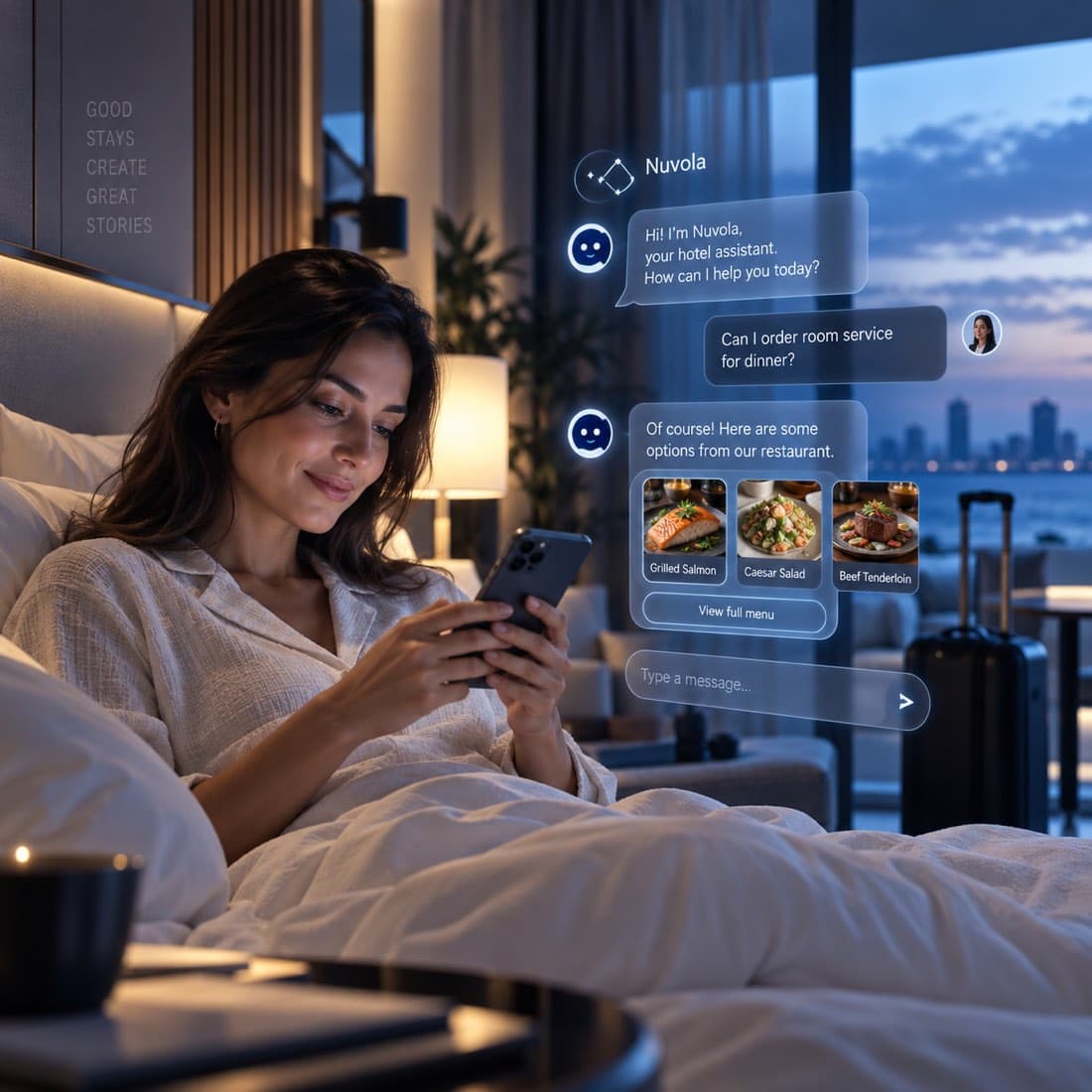
The Experience Gap
A gap exists not only in the guest experience — but in how efficiently hotels operate behind the scenes.
Process
- 1
Discovery
- 2
Definition
- 3
Design
- 4
Validation
- 5
Iteration
Approach
Rather than replace the guest-staff relationship, the AI Assistant was scoped as a first line of response: fast, always-on, and honest about what it is. A short set of UX guidelines anchored every screen — from how the AI introduces itself to when it must step aside for a human.
Guidelines
- Make it unmistakable the guest is talking with an AI, not a human — a distinct icon and message styling.
- Detect (or ask for) the guest's language and respond in kind — the assistant is multilingual by default.
- Give the guest a plain-language way out at any time — typing “agent” always escalates to a human.
- Surface the hotel's most common requests as quick options instead of open-ended typing.
- Keep responses short and scannable — one idea per message bubble.
- Never claim to store personal data the guest hasn't explicitly given it permission to use.
- Close every handled conversation with a lightweight satisfaction rating.
How it works
Hotel staff configure the assistant once — a greeting message, an escalation keyword, active hours per day of week — and train it against a categorized FAQ library (check-in/out, amenities, events, pets). From there, the assistant handles first-contact guest messages on its own, and only escalates when a guest asks for a person, requests something outside its FAQ scope, or explicitly needs a ticket created.
Interfaces
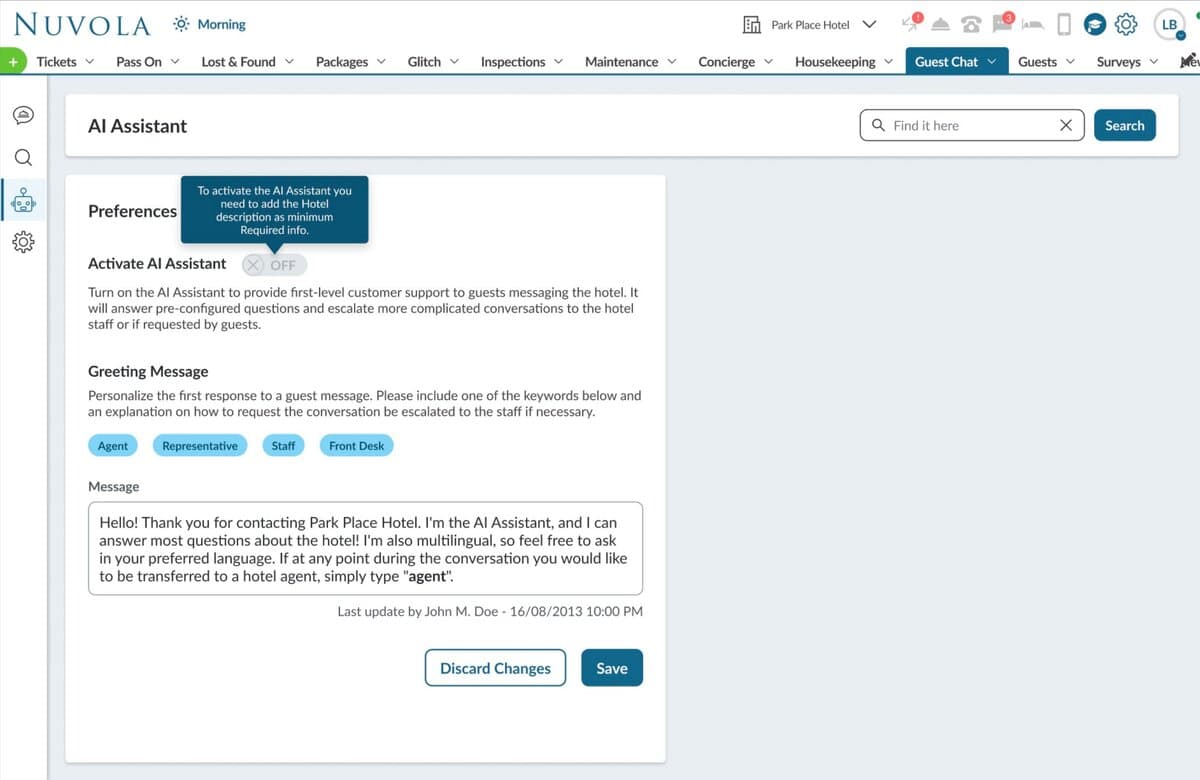
Staff configuration
Staff turn the assistant on for specific shifts and write its greeting — including the exact keyword guests can use to reach a human.
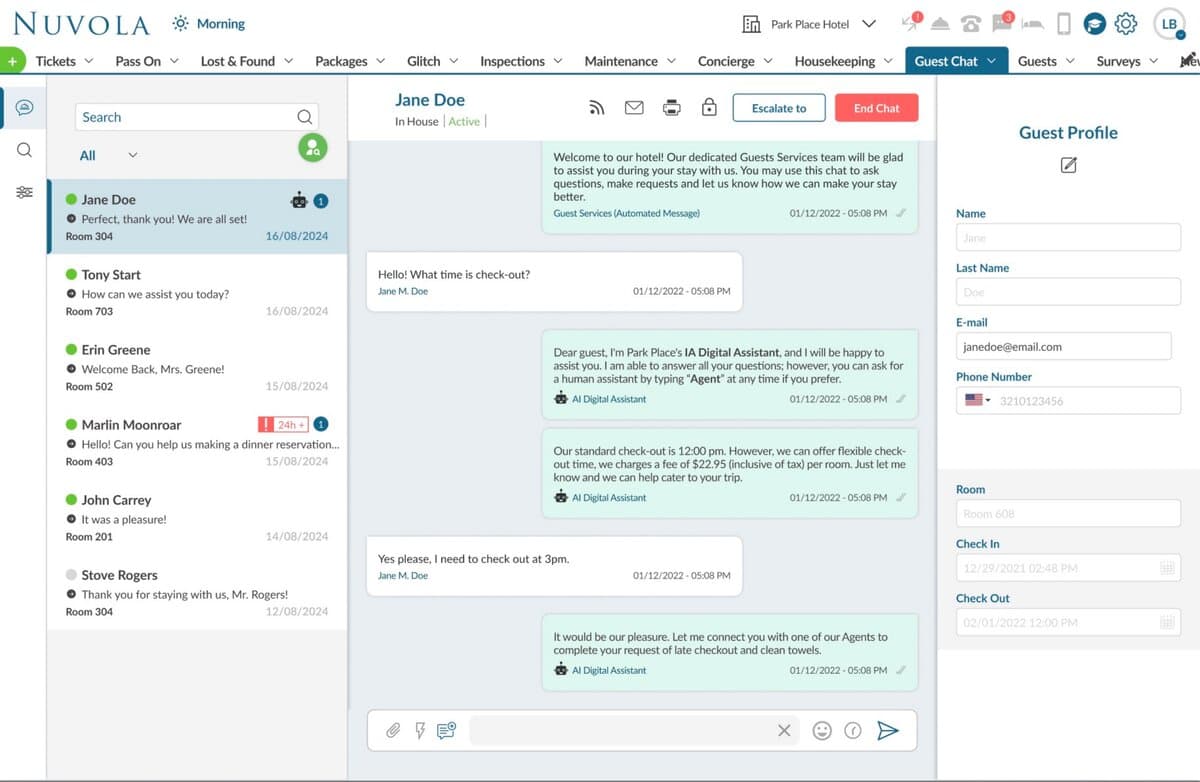
Guest conversation
The assistant identifies itself immediately and answers routine questions like check-out times.
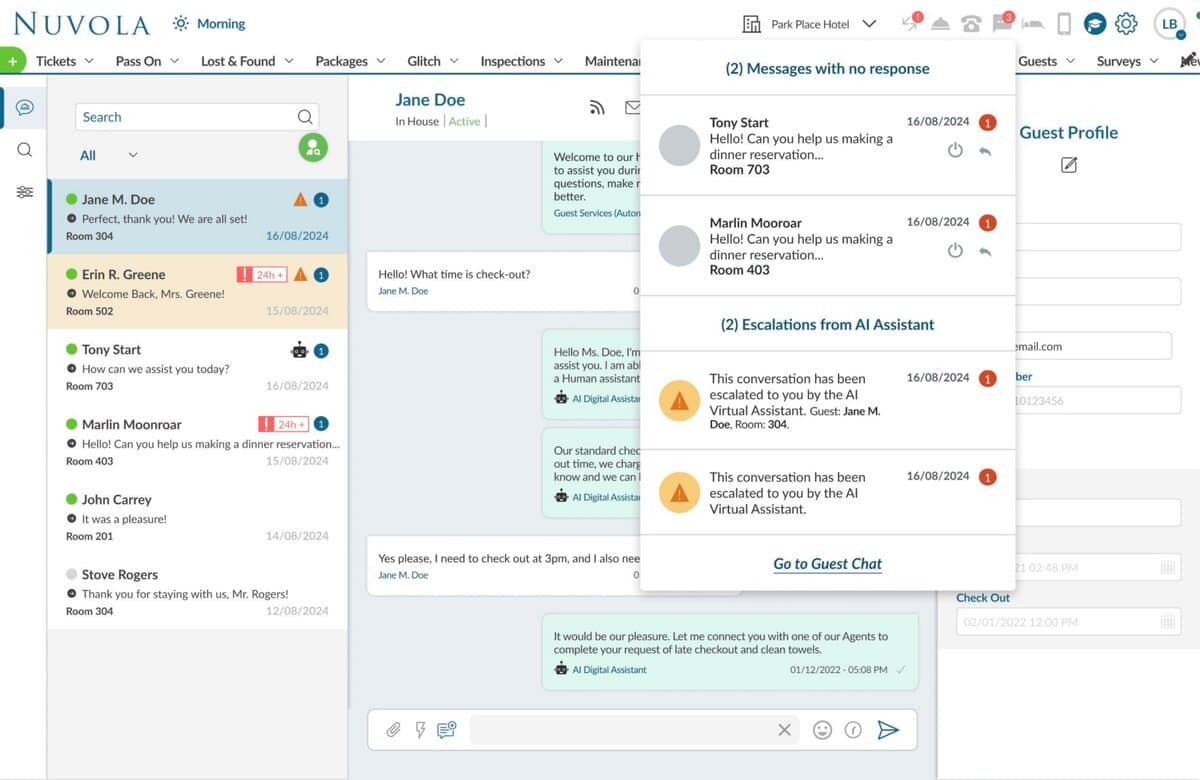
Escalation queue
Conversations the AI can't resolve surface to staff as a clearly flagged queue, never silently dropped.
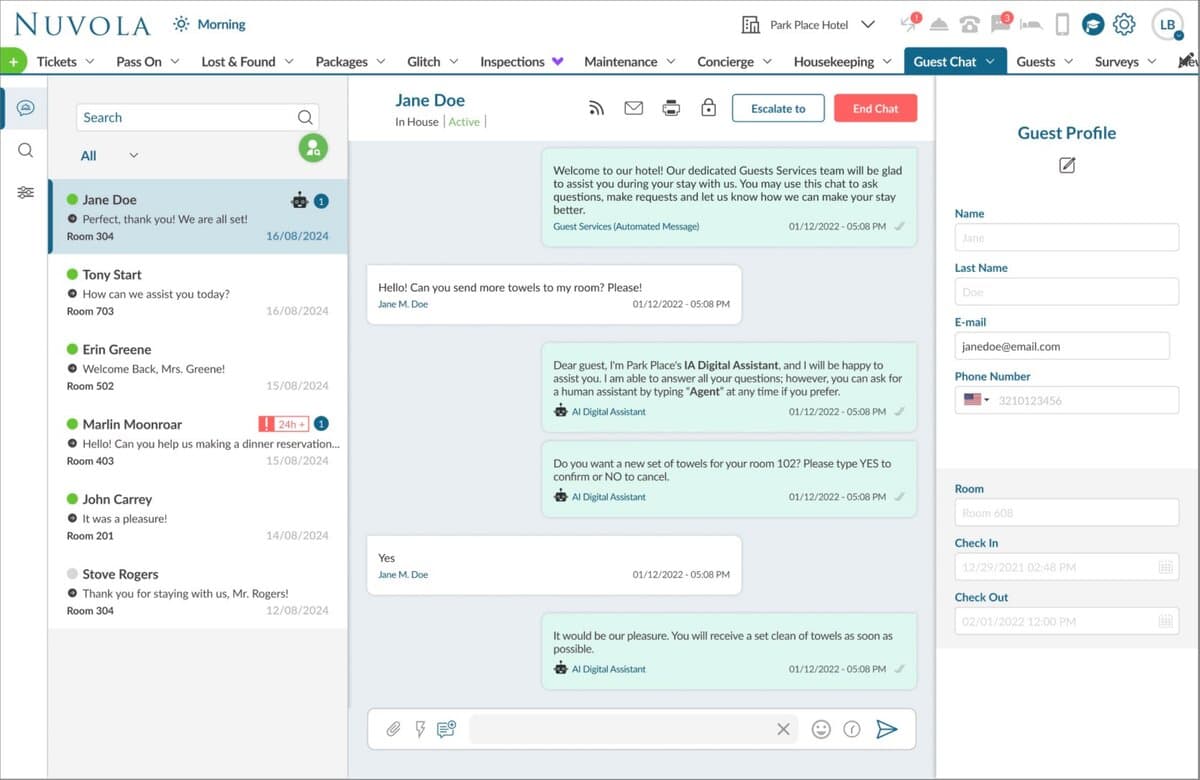
Ticket handoff
A confirmed guest request (here, extra towels) becomes a real operational ticket automatically — no re-typing by staff.
Try the flow
A simplified, self-contained model of the guest message → intent recognition → staff ticket flow described above. No real backend — everything here is mock data running in your browser.
Guest Chat
Simulated — Park Place Hotel
Staff View — Tickets
What the AI hands off, in real time
Nothing yet — try “Can I get extra towels?” or ask for a person.
This is a simplified, illustrative model of the intent-recognition → escalation flow — not the shipped product. Try the quick replies, or type your own message (try the word “agent”).
Impact
Reflection
The hardest design problem here wasn't the chat UI — it was the handoff. An AI assistant that hides what it is, or that traps a guest with no way to reach a person, erodes trust fast. The UX guidelines that came out of this project (disclose, offer an out, keep it short) ended up mattering more than any single screen.